English
 French
 Arabic
 Bulgarian
 Czech
 Danish
 German
 Greek
 Spanish
 Finnish
 Hungarian
 Indonesian
 Italian
 Hebrew
 Japanese
 Korean
 Dutch
 Polish
 Portuguese, International
 Romanian
 Russian
 Slovak
 Swedish
 Thai
 Turkish
 Ukrainian
The word for a tree is 树 , and the wood it is made of is 木头 . The character 木 is the drawing of a tree: a trunk, two branches, two roots. It is hardly ever used on its own for “tree” any more, but it is everywhere as a component. Two trees, 林 , make a wood; three, 森 , a forest, hence 森林 (see The Earth and its landscapes). A stroke at the foot of the tree marks the root: this is 本 , the origin, the one in 根本 and in 日本, Japan, “the origin of the sun”. A man leaning against a tree, 休 , is resting.
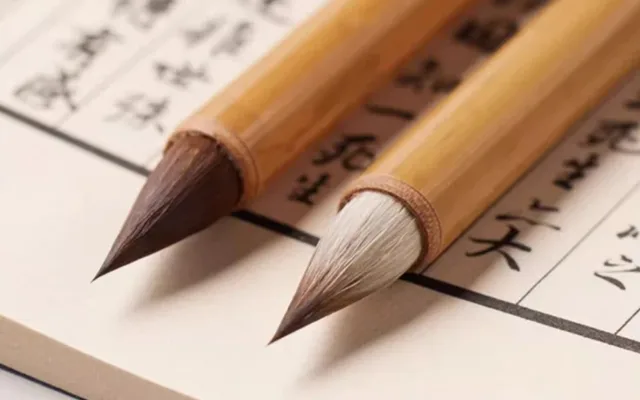
Almost all the names of trees are written with this wood radical, placed on the left: 松 the pine, 柳 the willow, 柏 the cypress, 枫 the maple, 槐 the pagoda tree. In speech, 树 is added to them: 松树, 柳树. Careful: bamboo is not one of them. 竹 has a radical of its own, which sits at the top of the character and marks the things that used to be made of bamboo: the brush 笔 , chopsticks 筷 , the basket 篮 , the box 箱 . Botanists, as it happens, class it among the grasses. Chinese writing, for its part, put it neither with the trees nor with the grasses.
The flower, 花 , is written with the grass radical sitting on top of 化 , which gives the sound. It is a late form (it spreads around the fifth century, unless I am mistaken). The old character was 華, today 华 , which now keeps only the sense of “splendour” and serves to name China: 中华 . The grass radical tops everything that grows without making wood: 草 , 茶 , 菜 , medicine 药 , and most of the flowers on this page (for vegetables, see Fruit and vegetables).
You do not count a tree the way you count a flower. A tree is 一棵树 (sentence 6): 棵 is used for anything that stands on its own stem, a cabbage included. A flower is 一朵花 (sentence 2), and 朵 counts clouds as well. A bunch of flowers is 一束花 (sentence 3), a leaf 一片叶子. As for the verbs, flowers “open”, 开 , and then they “take their leave”: 谢 . It is the same character as in 谢谢. Its first meaning is to withdraw, to decline: the fading flower takes itself off, and so does the person who says thank you.
The Chinese have given plants a character, in the moral sense of the word. Four of them are the “Four Gentlemen”, 四君子 (sentence 19): the plum 梅, the orchid 兰, bamboo 竹 and the chrysanthemum 菊, one for each season. The plum blossoms in the depths of winter, on bare wood, and 王安石 Wang Anshi drew its portrait in ten characters (sentence 22). Bamboo bends and does not break; it is hollow, and therefore modest. Together with the pine, these two make up the “Three Friends of Winter”, 岁寒三友 . These are the subjects that every scholar-painter worked at (see Bamboo in Chinese gongbi painting).
The chrysanthemum, 菊花 , is the flower of autumn and of those who withdraw from the world, ever since 陶渊明 Tao Yuanming left his post to go and pick some at the foot of his hedge (sentence 23). On the other hand, do not give them as a present: white or yellow, they are now the flower of funerals, as they are in France on All Saints’ Day (sentence 14). The lotus has two names for a single plant: 荷花 in conversation, 莲花 in texts and at the temple. It grows in the mud and comes out of it clean, which 周敦颐 Zhou Dunyi said once and for all in the eleventh century (sentence 24). The peony, 牡丹 , the flower of Luoyang (sentence 10), stands for wealth, with no moral pretensions. It vies with the plum blossom for the title of national flower, 国花 , which the People’s Republic has never officially awarded.
A few trees have a story. The ginkgo, 银杏 , is literally the “silver apricot”. It is also called 公孙树, “the grandfather-and-grandson tree”, because it grows so slowly that whoever plants it will not see its fruit (sentence 12). That is the idea behind the proverb 前人栽树,后人乘凉. The 梧桐 is the tree on which the phoenix alights. But the 法国梧桐, the “French wutong” that line the avenues of Shanghai and Nanjing, are plane trees: all they have of the wutong is the leaf, and their name is said to come from the old French Concession. As for the willow, it used to be given to someone who was leaving: 柳 sounds almost like 留 , to make someone stay.
The expressions on this page often have a date. 胸有成竹 comes from a Song painter, 文同 Wen Tong, who was said to have the whole bamboo in his chest before he set brush to paper (sentence 20). 百花齐放 , “let a hundred flowers bloom”, is the slogan launched by Mao in 1956 to invite intellectuals to speak out. The following year, those who had done so were condemned as “rightists”, and the expression is still read with that at the back of the mind. Older still is what Confucius said of a disciple who slept in broad daylight: 朽木不可雕也 (sentence 25, see Chapter 5 of the Analects of Confucius). 朽木 , rotten wood, is still said of someone who will never come to anything.
Plants have also grown into everyday words. 花 is a verb, to spend: 花钱, 花时间 (I do not know where this sense comes from). The root, 根 , gives 根据 , “according to”. Ordinary people are “grass roots”, 草根 , a calque of our own grassroots. The prettiest girl in the school is the “school flower”, 校花 . On social media, making someone want to buy something is “planting grass”, 种草 ; once the thing is bought, you “pull the grass up”, 拔草 . The garden and house plants are on the page Plants and animals. As for grass, 白居易 Bai Juyi said all there is to say (sentence 21). It always grows back.
Click on any character on the page: its stroke order appears stroke by stroke, with the arrow showing the direction of the line.
How to use this page: every word carries its level. ① the essentials, ② the common, ③ the precise. Start with the ①: they are already enough to name the trees in a park, buy a bunch of flowers or talk about the flowers you like. The ▶ button gives the pronunciation, and a click on a character opens its stroke order.
The tree
tree
big tree
(measure word for trees and plants)
tree leaf
wood (the material)
to plant a tree
branch
trunk
root (of a tree)
bark
shade of a tree
trees (collective term)
to plant trees, to reforest
to chop, to cut down
red leaves (of autumn)
sapling
treetop
growth rings (of a trunk)
branches and leaves, foliage
evergreen
Tree species
bamboo
pine
willow
peach tree
ginkgo
maple
maple leaf
mulberry tree
poplar
bamboo leaf
cypress
pagoda tree (sophora)
Chinese parasol tree (and, loosely, the plane tree)
banyan
China fir
oak
palm tree
pine and cypress (steadfastness)
The flower
flower
(measure word for flowers)
fresh flowers
to give flowers
to buy flowers
wild flower
bloom, blossom (the flower head)
petal
bunch of flowers, bouquet
to be in full bloom
to go and admire the flowers
pollen
(flower) bud
to wither, to drop
flowering season
national flower
Flowers by name
rose
plum blossom
lotus (the flower)
chrysanthemum
peach blossom
peony
orchid
cherry blossom
osmanthus
jasmine
sunflower
lily
lotus (in written language and in Buddhism)
tulip
narcissus
azalea
carnation
China rose
morning glory
wisteria
camellia
rapeseed flower
the Four Gentlemen (plum, orchid, bamboo, chrysanthemum)
the Three Friends of Winter (pine, bamboo, plum)
Grasses and plants
grass
blade of grass
flowers and plants
green leaf
root
wild grass
green grass
thorn
lotus leaf
wild
fruit (in the botanical sense)
lush
weed
stem
vine, climbing stem
shrub
reed
moss
dandelion
clover
lavender
photosynthesis
vegetation
Trees and flowers in sayings
let a hundred flowers bloom
to have the finished bamboo in one’s chest: to know exactly where one is going
like splitting bamboo: an unstoppable advance
dark willows, bright flowers: the way out after the dead end
the flower that lasts a single night: a flash in the pan
to offer the Buddha someone else’s flowers
deep-rooted
to take every blade of grass for a soldier
a single tree does not make a forest
ten years to grow a tree, a hundred years to form a person
those who came before plant the tree, those who come after enjoy the shade
the tree longs for calm, but the wind will not drop
plant a willow without a thought, and there it is giving shade
Trees and flowers in everyday words
to spend time
fundamental; (not) at all
according to, on the basis of
to spend; expense
spark
to have blurred vision
the prettiest girl in the school
“grass roots”: ordinary people
to make someone want to buy (internet slang)
sprout; first beginnings
the main beam: the pillar (of a country)
Example sentences
There are a lot of trees in the park.
How pretty this flower is!
I’d like to buy a bunch of flowers to give to Mum.
Spring is here, all the flowers have opened.
What’s your favourite flower?
There’s a big tree in front of my house.
What pandas like best is bamboo.
Autumn has come, the leaves have all turned yellow.
Every March, lots of people go to Wuhan to see the cherry blossom.
The peony is the most famous flower in Luoyang.
In summer, we often sit in the shade of a tree and chat.
This ginkgo is already more than a thousand years old.
The osmanthus is in bloom, the whole street smells sweet.
As a rule, you don’t give chrysanthemums to a friend.
Don’t pick the flowers in the park!
The lotuses in the pond are magnificent.
12 March is Arbor Day in China.
In autumn, crowds go to the Fragrant Hills to see the red leaves.
The plum, the orchid, bamboo and the chrysanthemum are known as “the Four Gentlemen”.
He has long known exactly where he is going with this, don’t worry.
The wildfire cannot burn it all away: in the spring wind, it grows back.
At the corner of the wall, a few branches of plum; braving the cold, they blossom alone.
I pick chrysanthemums by the eastern hedge; far off, at ease, I catch sight of the Southern Hills.
It rises from the mud unsullied; it bathes in the clear ripples without coquetry.
A piece of rotten wood cannot be carved.