 English
 French
 Arabic
 Bulgarian
 Czech
Czech
 Danish
 German
 Greek
Greek
 Spanish
 Finnish
 Hungarian
 Indonesian
 Italian
 Hebrew
 Japanese
 Korean
 Dutch
Dutch
 Polish
 Portuguese, International
 Romanian
 Russian
 Slovak
 Swedish
 Thai
Thai
 Turkish
 Ukrainian
Chinese seal generator
Enter your name in Chinese characters: the generator composes a seal, 印章 , in 方篆 script, in two versions, to download as a transparent PNG.
You do not have a Chinese name yet? Get your name in Chinese characters
Enter your name in Chinese characters: Latin letters cannot be carved on a seal.
Get your name in Chinese characters
Only the Chinese characters were kept. Letters, digits and punctuation cannot be carved on a seal.
A seal takes 9 characters at most. Shorten your name.
The seal script font does not have these characters:
That is a long name for a seal. A real Chinese name, in 2 or 3 characters, would sit far better in the stone. Xiaoqian can choose one for you and carve it.
Yin seal: 白文
The characters are cut away: they stay blank in the red field. This is the older of the two styles.
Download the PNGYang seal: 朱文
The characters are left standing: they print red, inside a red frame. This is the style of most artists’ seals.
Download the PNGTransparent background: you can drop the image straight onto a painting, a calligraphy or a document.
A real seal, carved by hand
The seal above is an image, and it costs nothing. If it is the object you want, Xiaoqian carves her seals by hand in the stones meant for that (Qingtian, Shoushan, Hongshi, Dongshi and others): she draws the composition first, then cuts it with the knife. The video shows an extract of it, and the whole job takes far longer than one imagines.
She also translates your first name and family name into Chinese, which settles the problem of the over-long name: you then carry a real Chinese name on your seal instead of a transcription. She sells the seal paste as well, 印泥 , without which the stone stays idle. Seals from 26,90 €, shipped from France, no customs fees within the European Union.
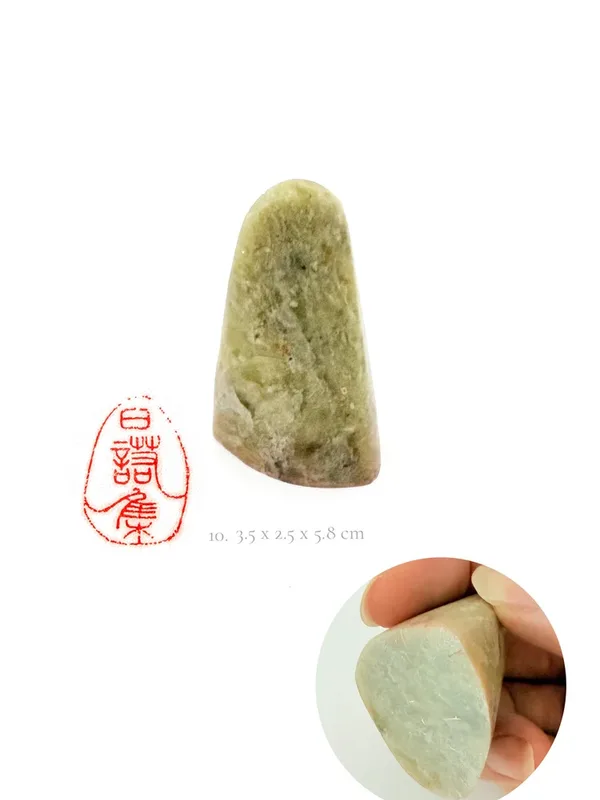
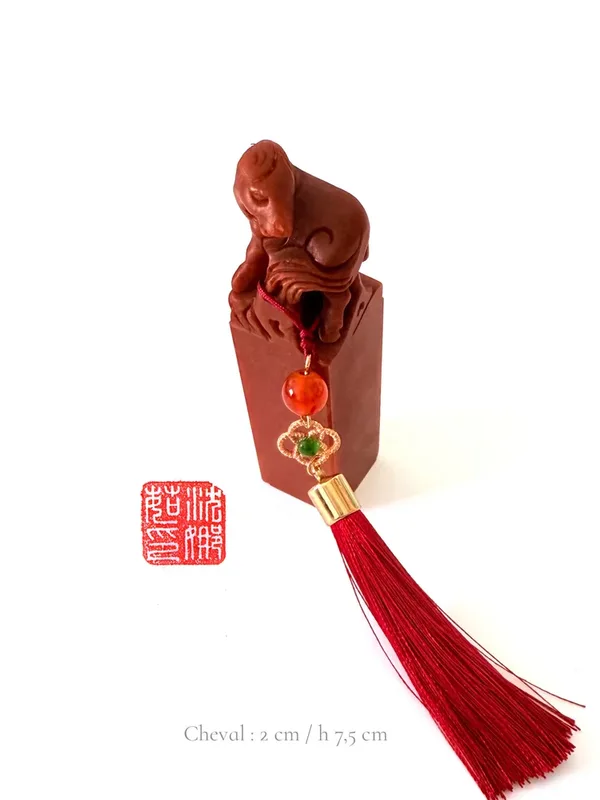
Two pieces from the shop: a Qingtian stone left in its rough shape, and a seal topped with a carved horse. Every stone is unique, and its impression is shown beside it.
See the hand-carved sealsThe Chinese seal
A seal, 印章 , is the carved stone that does in China what a signature does here. It closes a letter, validates a contract, and above all it signs a painting or a calligraphy. Pressed into the seal paste, 印泥 , it leaves the deep red that this generator tries to reproduce. Pastes differ by what goes into them, and the most sought after are made with cinnabar, 朱砂 .
The characters are set in columns read from top to bottom, and the columns run from right to left. When the name does not fill the grid, three characters in a square of four for instance, the free box takes the character 印 , « seal » (old seals also use 之印 , but the generator sticks to a single character). It is not padding: 李天翔印 reads literally « seal of Li Tianxiang ».
The script used here is the 方篆 : 方 « square » + 篆 « seal script » ⟶ the seal script squared off so that every character fills its box exactly. On a round or an oval seal the 圆篆 is preferred, its strokes following the curve. A Chinese person today can barely decipher either of them, and that is on purpose. A seal is looked at first, and read afterwards.
Two styles have coexisted for centuries. The yin seal, 白文 , literally « white writing », has its characters hollowed out: the knife removes the strokes, which print blank in a red field. The yang seal, 朱文 , « vermilion writing », does exactly the opposite. Painters often own one of each and change according to the work, or press both on the same painting.
An image is not a seal, though, and it is worth saying. What the generator cannot do is precisely what makes a carved seal worth owning: the accidents of the knife, the border deliberately chipped, the way a carver tightens one character to let the next one breathe. A font, for its part, always does the same thing.
One practical point to finish. A Western first name transcribed by sound quickly runs to four or five characters, and the seal turns into a crowded grid that means nothing to a Chinese reader. If you come from the Chinese first name page, take a family name of one character and a given name of one or two instead. That is what everyone does in China.
Follow us


网上汉语 · learn-chinese.online
Chinese course
Level 1 · Beginner学
中
文
A clear, structured method to get started in Mandarin.
✓Units 1 to 5 — freeLessons, exercises and assessments, full access.
🔓Units 6 to 10 — open accessThe course to read, without exercises or assessments. No login needed.
Start for freeImmediate access to level 1
The HanWen Shop
Quality Chinese craftsmanship, shipped from France
🇫🇷 A shop based in France