English
 French
 Arabic
 Bulgarian
 Czech
 Danish
 German
 Greek
 Spanish
 Finnish
 Hungarian
 Indonesian
 Italian
 Hebrew
 Japanese
 Korean
 Dutch
 Polish
 Portuguese, International
 Romanian
 Russian
 Slovak
 Swedish
 Thai
 Turkish
 Ukrainian
A Chinese font requires thousands of drawings, and most of those found online belong to type foundries (方正 , 汉仪 …). They are often “free”, but for personal use only: as soon as you put them on a website or in a document that is distributed, you need a licence. This is what led us to replace all the fonts on chine-culture.com with open-source or free fonts.
This page brings together the result of that work: first the ancient-script fonts we have made and that you can download, then a list of other open-source or free Chinese fonts, with their strengths and their limits.
The Chine-Culture family: three ancient scripts
These three fonts reproduce ancient forms of the characters. The outlines come from the ACC (Ancient Chinese Characters) project of Wikimedia Commons, which placed them in the public domain; we selected them, assembled them and encoded them as fonts. The PROVENANCE.csv file, supplied with each font, gives the source of every character.
The same drawing is assigned to both the simplified and the traditional character: whether you type 国 or 國, you get the same ancient form. However, far from every modern character has an ancient form: a missing character is displayed in your computer’s fallback font. The percentage given for each font refers to the 3,500 most common characters (level 1 of the 通用规范汉字表 ).
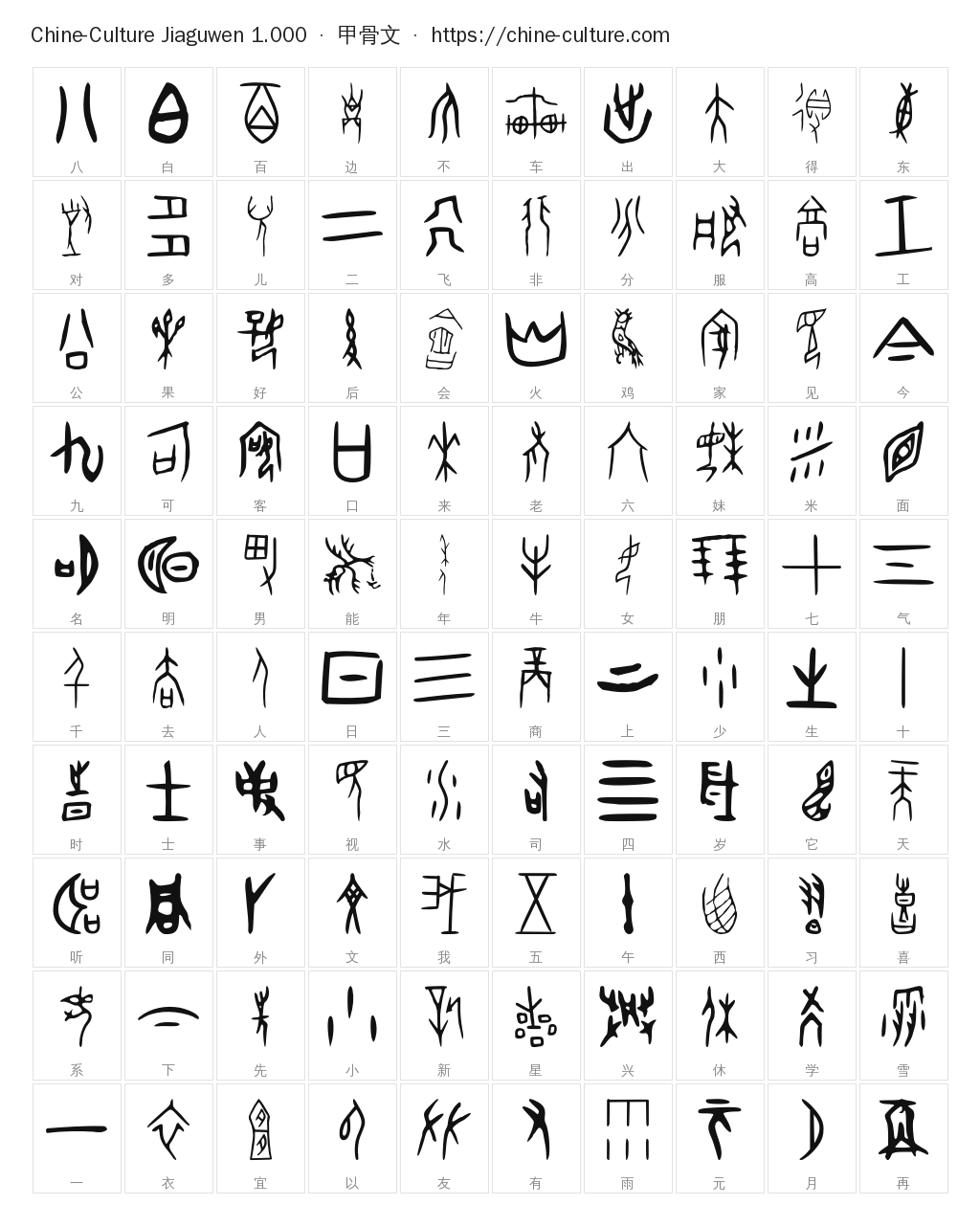
Chine-Culture Jiaguwen 甲骨文
甲骨文 literally “writing 文 on shells 甲 and bones 骨” ⟶ divination inscriptions of the Shang (c. 1300-1050 BC).
877 characters drawn; 603 of the 3,500 common characters (17%).
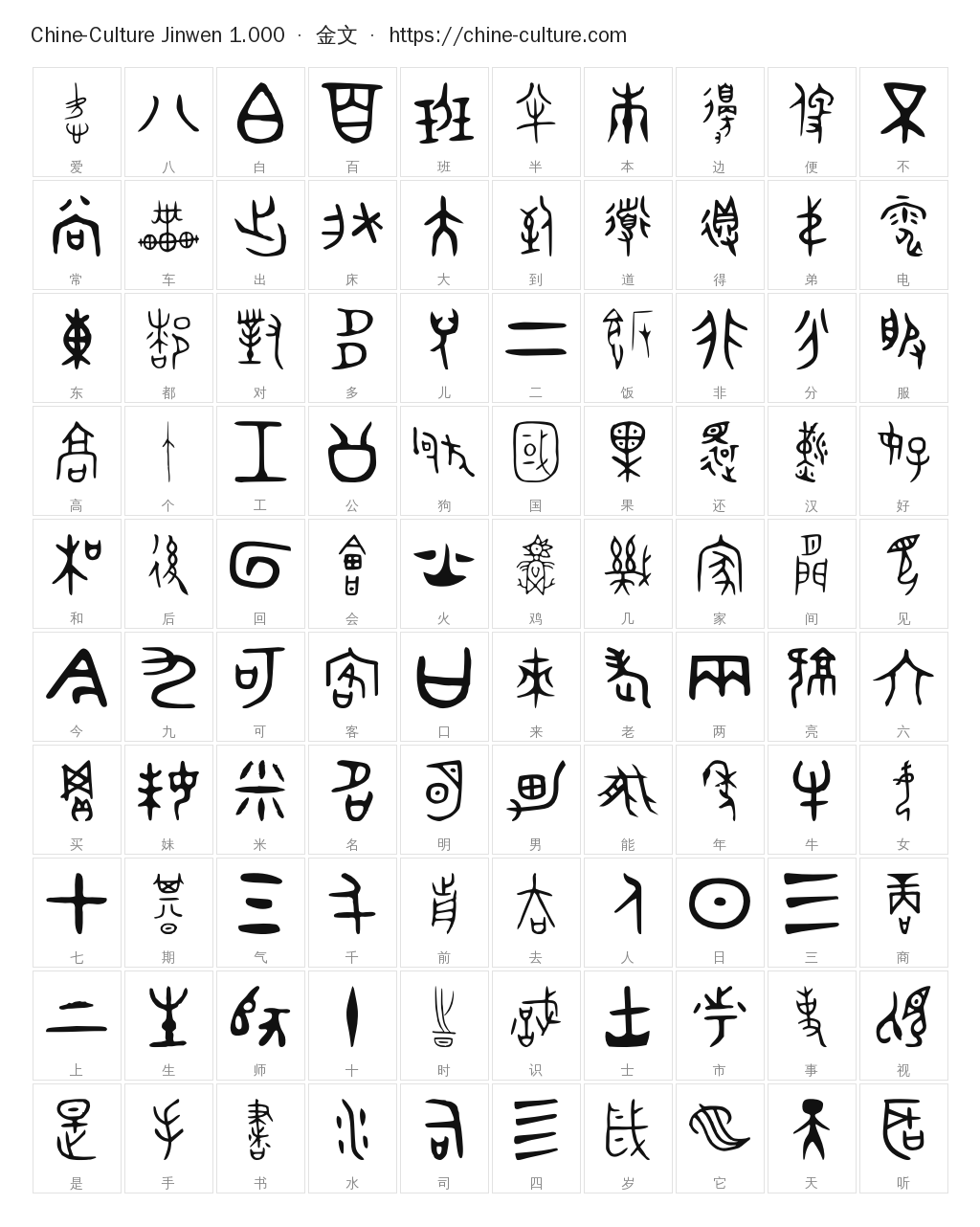
Chine-Culture Jinwen 金文
金文 literally “writing on metal 金” ⟶ inscriptions cast in the ritual bronzes of the Shang and Zhou.
1,302 characters drawn; 872 of the 3,500 common characters (25%).
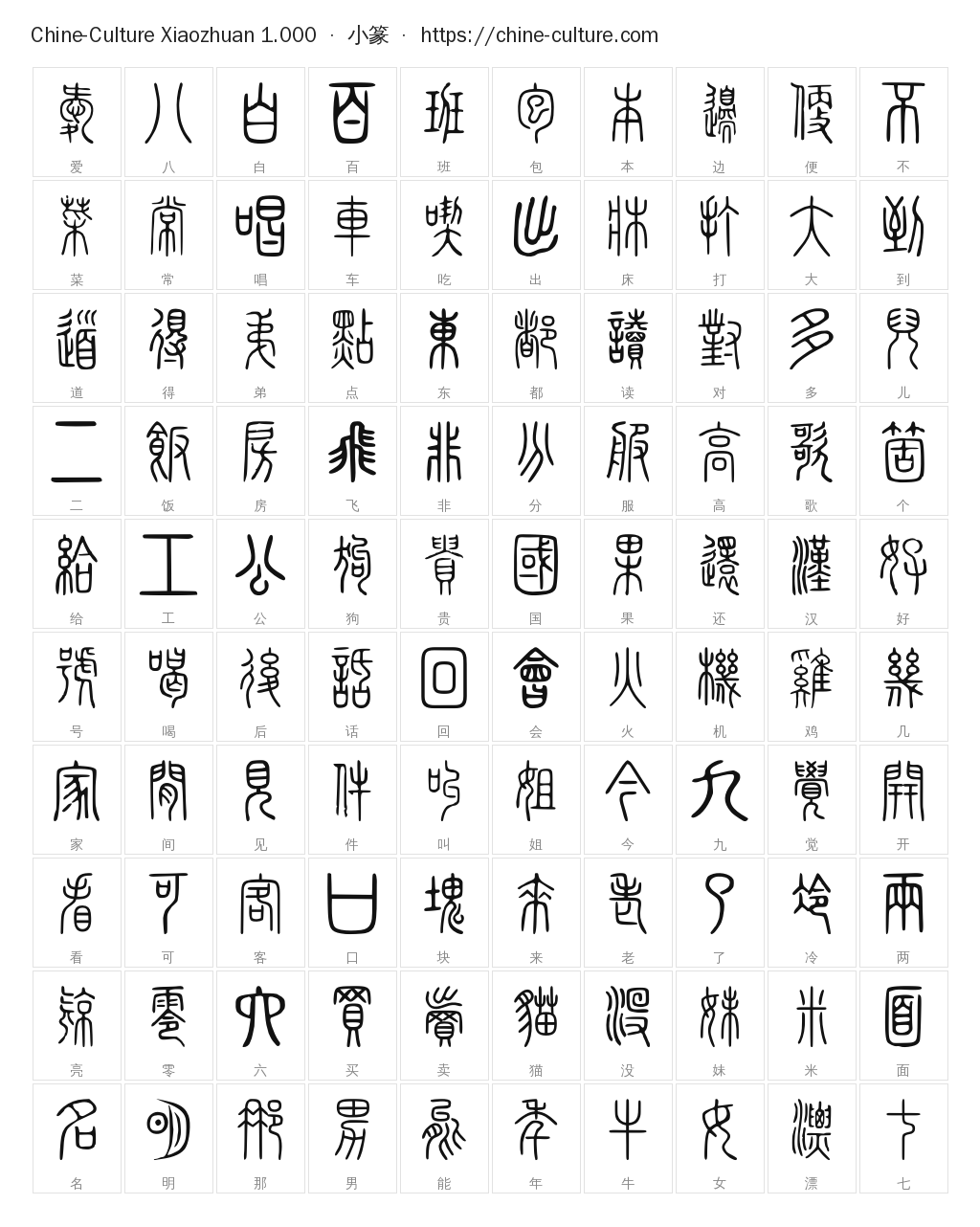
Chine-Culture Xiaozhuan 小篆
小篆 literally “small 小 seal script 篆” ⟶ the script unified under the Qin, the one used in the 说文解字 .
3,883 characters drawn; 1,814 of the 3,500 common characters (52%).
Download all three fonts (6.7 MB)
Each archive contains the font to install (OTF), the web version (WOFF2), the specimen, the provenance file and the licence. The three fonts are released under the SIL Open Font License 1.1: you may use them, including in commercial work, modify them and redistribute them; only the name “Chine-Culture” is reserved (a modified version must bear another name).
Please note: for a given character, ancient inscriptions often offer several forms, and we had to choose one. That choice is open to debate, and a few errors have surely slipped through proofreading. If you find one, please let us know through the contact form.
Other open-source or free Chinese fonts
Before choosing, two questions matter more than style. First, the licence: most of the fonts below are under the OFL (free use, including commercial use and on the web); others forbid modification (CC BY-ND) or require the source to be credited. Second, the script covered: very few open-source fonts contain both simplified and traditional characters. A “simplified only” font will display nothing, or a fallback font, for 學; a Taiwanese font will give Taiwanese forms, which are not always those of Beijing.
The links lead to the authors’ official pages (checked on 2 November 2026). Fonts marked with an asterisk are the ones this site uses.
Regular script 楷书
| Font | Licence | Script | Remarks |
|---|---|---|---|
| FandolKai* | GPL + font exception | simplified | Correct mainland forms, a good model for handwriting; no traditional characters. |
| TW-Kai 全字庫正楷體* | OGDL-Taiwan or OFL, source attribution required | traditional | Official Taiwanese form, huge coverage; rare characters are in a separate file. |
| 教育部標準楷書 | CC BY-ND | traditional | Taiwan’s school reference for stroke shapes; modification forbidden. |
| AR PL UKai* | Arphic Public License | simplified and traditional | A single font for both scripts; but a few old forms (眞 for 真), so best avoided as a model for beginners. |
| LXGW WenKai 霞鹜文楷 | OFL | simplified and traditional | Readable, warm pen handwriting in three stroke weights (light, regular, bold); it is not a calligrapher’s 楷书. |
| LXGW WenKai TC | OFL | traditional (inherited forms) | Beautiful for classical texts; its forms are not the ones taught in Taiwan. |
| Iansui 芫荽 | OFL | traditional | Supple handwriting with Taiwanese forms, zhuyin included; character set still incomplete. |
Printing script 宋体 and 仿宋
| Font | Licence | Script | Remarks |
|---|---|---|---|
| Source Han Serif 思源宋体 (or Noto Serif CJK) | OFL | simplified and traditional | Professional quality, several stroke weights, versions by region (China, Taiwan, Hong Kong); large files. |
| TW-Sung 全字庫正宋體 | OGDL-Taiwan or OFL, source attribution required | traditional | Huge coverage, official Taiwanese form; drier design. |
| I.Ming 一點明體 | IPA Font License | inherited forms | All the characters of the Kangxi dictionary, ideal for classical texts; confusing for a beginner. |
| Zhuque Fangsong 朱雀仿宋 | OFL | simplified and traditional | The only serious open-source 仿宋, beautiful for quotations; still in pre-release. |
Sans-serif 黑体 and rounded 圆体 scripts
| Font | Licence | Script | Remarks |
|---|---|---|---|
| Source Han Sans 思源黑体 (or Noto Sans CJK) | OFL | simplified and traditional | The most readable on screen, the de facto reference; large files. |
| Plangothic 遍黑体 | OFL | rare characters | Displays the characters of extensions B to J, missing elsewhere; always used together with Source Han Sans. |
| jf open Huninn 粉圓 | OFL | traditional | Very readable rounded script, zhuyin included. |
Pen handwriting 硬笔书法
| Font | Licence | Script | Remarks |
|---|---|---|---|
| 猫啃硬笔楷书* | OFL | simplified | Genuine pen handwriting with correct forms: a realistic model for students. |
| The Peak Font 隨峰體* | OFL | traditional | The same hand as the previous one; reduced character set (about 6,100 characters). |
Brush calligraphy
| Font | Licence | Script | Remarks |
|---|---|---|---|
| MasaFont 正風毛筆* | OFL | traditional | Brush semi-cursive 行书 in five stroke weights; only the regular weight is really polished. |
| Zhi Mang Xing 志莽行書 | OFL | simplified | Semi-cursive with linked strokes. |
| Long Cang 龙藏体 | OFL | simplified | Lively strokes, but few links between them: this is not a true 行书. |
| Liu Jian Mao Cao 刘建毛草* | OFL | simplified | The only serious open-source cursive 草书; unreadable for a learner without a transcription. |
| Ma Shan Zheng 马善政 | OFL | simplified | Brush rendering for posters and New Year couplets 春联; not a model of 楷书. |
Ancient scripts
| Font | Licence | Script | Remarks |
|---|---|---|---|
| 崇羲篆體* | CC BY-ND | traditional | Small seal script 小篆 from Academia Sinica, 11,596 characters; simplified characters display nothing without conversion. |
| 教育部隸書* | CC BY-ND | traditional | Official, clean clerical script 隶书; only 4,808 characters. |
Free, but with an unclear licence
These fonts are distributed free of charge, without a clear written licence. You can use them, but without any guarantee: it is up to you to judge.
| Font | Status | Script | Remarks |
|---|---|---|---|
| 瑞美加张清平硬笔行书* | author’s statement: free use, modification and resale forbidden | simplified | The most beautiful pen 行书 we have found, with truly linked strokes. |
| 瑞美加张清平硬笔楷书 | same statement | simplified | The 楷书 counterpart of the previous one; defects reported on Mac. |
| 全字庫說文解字 | personal use stated, no licence | 6,721 characters | Small seal script of the Shuowen, government source; incomplete Unicode encoding, old font. |
| 王漢宗自由字型 | GPL (no known font exception) | simplified and traditional, in separate fonts | Many styles (颜楷, 魏碑…); project discontinued since 2004, official page hard to access. |
Which one to choose?
For a text that must display both simplified and traditional characters, Source Han or Noto remain the safest choice. For a handwriting model, it is better to use a font that follows the standard of the script being taught: FandolKai or 猫啃硬笔楷书 for simplified, TW-Kai or the 教育部標準楷書 for traditional (this is what our writing grid generator does). For brush calligraphy, the open-source choice remains thin, especially in simplified characters.
The authors and licences of the fonts used on this site are detailed in the font credits. Many open-source styles are still missing. We will add to the list as we make new discoveries.