English
 French
 Arabic
 Bulgarian
 Czech
 Danish
 German
 Greek
 Spanish
 Finnish
 Hungarian
 Indonesian
 Italian
 Hebrew
 Japanese
 Korean
 Dutch
 Polish
 Portuguese, International
 Romanian
 Russian
 Slovak
 Swedish
 Thai
 Turkish
 Ukrainian
Here is a Chinese character writing grid generator in A4 format to help you learn to write beautiful sinograms with a ballpoint or fountain pen. This module generates a PDF file that you can download and print. Enjoy your practice!
This generator produces A4 writing grids in PDF format, to print out and practise tracing Chinese characters. You enter a series of characters, then choose a style and a type of box: each character is reproduced in grey across a whole line, followed by an empty line for practice.
The types of box
The 米字格 (literally “box of the character 米”) is divided by a cross and two diagonals; the 田字格 (“box of the character 田”) by a simple cross. These guide lines help you place each stroke and keep the character's proportions. The empty square is for those who no longer need them (or who enjoy making life difficult for themselves).
The three styles
- 楷书 , regular script: this is the reference form, the one found in textbooks. The characters follow the mainland China standard for simplified and the Taiwan standard for traditional. This is where you should start.
- 硬笔楷书 , regular script with a pen: the same characters, as they are written by hand with a pen. It is the model for everyday handwriting, once the basics have been mastered.
- 硬笔行书 , semi-cursive with a pen: 行书 literally “walking script” ⟶ running script. The strokes are joined together and some are shortened. It is intended for advanced learners who have mastered the stroke order of 楷书, because a misunderstood link quickly becomes a mistake.
Please note: 硬笔行书 is only available here in simplified characters. I have not found any free pen font for 行书 in traditional characters; if you enter traditional characters, the generator suggests switching to 硬笔楷书. For the other two styles, it recognises on its own whether your text is in simplified or traditional characters.
Pen calligraphy
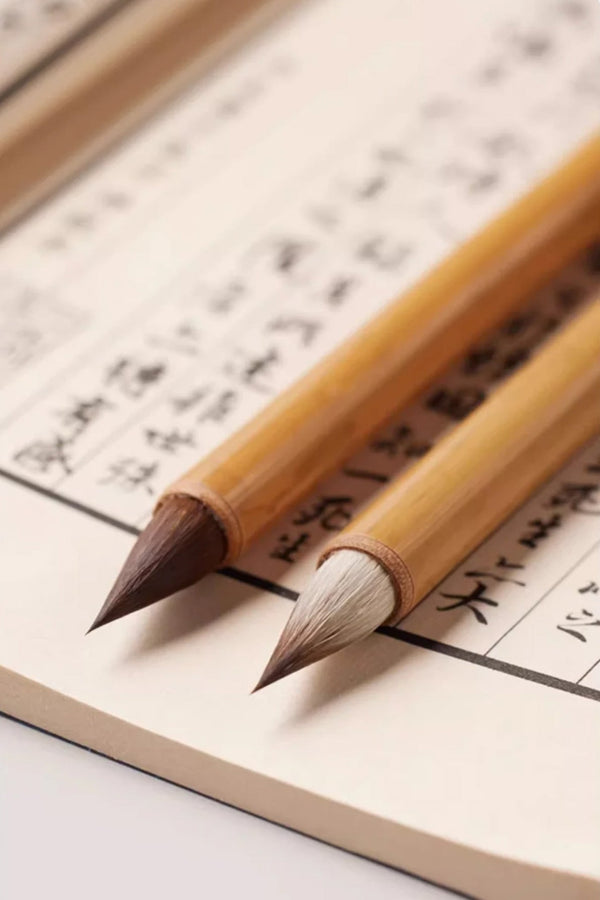
硬笔书法 is calligraphy with a pen: 硬笔 “hard brush” ⟶ pen, pencil, as opposed to the 毛笔 , the hair brush. In China, it is a practice in its own right. Pupils train to write well (练字 ) in model copybooks, the 字帖 , and people are fond of saying 字如其人 , literally “the writing is like the person”.
But a pen is not a brush: no pronounced thick and thin strokes, no play with the ink. What matters is the structure of the character, the balance of its components and the crispness of each stroke. For the brush, see the calligraphy generator and the page on the eight strokes of the character 永.
Pen fonts reproduce one person's handwriting, habits included: a character may therefore differ slightly from the one in the textbook. That said, no font can replace a teacher who corrects your handwriting.