 English
 French
 Arabic
 Bulgarian
 Czech
Czech
 Danish
 German
 Greek
Greek
 Spanish
 Finnish
 Hungarian
 Indonesian
 Italian
 Hebrew
 Japanese
 Korean
 Dutch
Dutch
 Polish
 Portuguese, International
 Romanian
 Russian
 Slovak
 Swedish
 Thai
Thai
 Turkish
 Ukrainian
The tone (声调 , literally “sound” 声 + “modulation” 调 ⟶ “modulation of the sound”) is the melodic pitch that comes with every syllable of Chinese. It is not an ornament: the tone is part of the word, just as much as a consonant is.
Four characters show it better than a long explanation. 妈 , 麻 , 马 and 骂 are all pronounced “ma”. Only the intonation separates them, and that is enough to move from “mother” to “hemp”, then to “horse”, then to “to swear at”. An English speaker whose voice rises at the end of a sentence, out of the reflex for questions, often says something other than what they mean.
Method
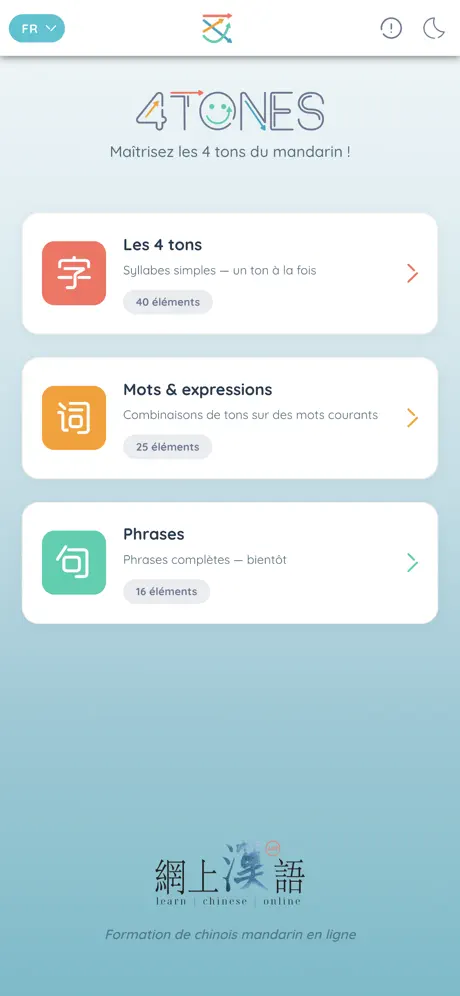
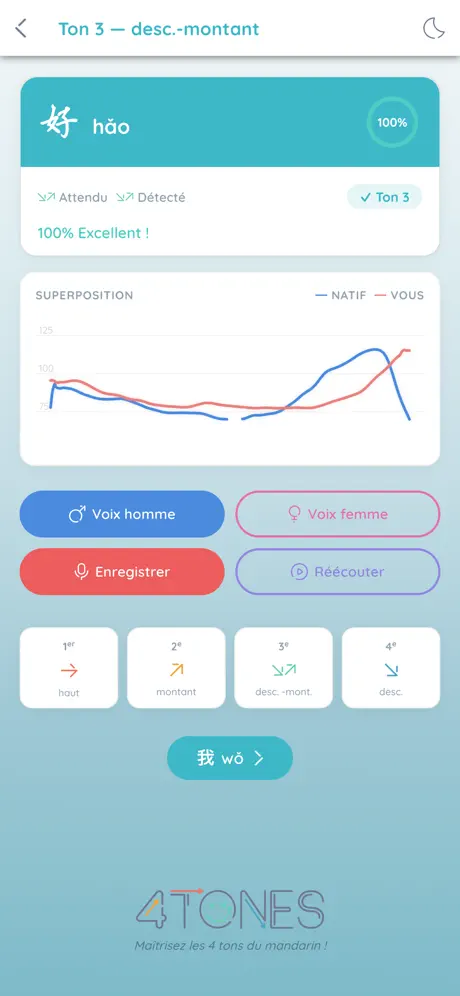
Choose a syllable by clicking its card, below. Listen to the Chinese speaker, then record yourself with the card on the right: the browser will ask permission to use the microphone, and the recording stops on its own after three seconds.
Then click “Overlay and analyse”. The two pitch curves are laid one over the other, brought to the same length, and you see at a glance where yours departs from the model.
Careful: the exercise judges intonation only, that is, the tone of the syllable. It says nothing about the sound itself (the “ma”). And the speaker’s tone is deliberately exaggerated: it is a training model, not a conversation.
Over to you.