 English
 French
 Arabic
 Bulgarian
 Czech
Czech
 Danish
 German
 Greek
Greek
 Spanish
 Finnish
 Hungarian
 Indonesian
 Italian
 Hebrew
 Japanese
 Korean
 Dutch
Dutch
 Polish
 Portuguese, International
 Romanian
 Russian
 Slovak
 Swedish
 Thai
Thai
 Turkish
 Ukrainian
The student of Chinese calligraphy must begin by learning the Regular style first. The Chinese say that studying calligraphy is like learning to walk. Learning the Regular style is like learning to stand. Learning the Running style is like learning to walk. And practicing the Grass style is like running.
Before embarking on learning calligraphy, the student must absolutely master the prerequisites, which are:
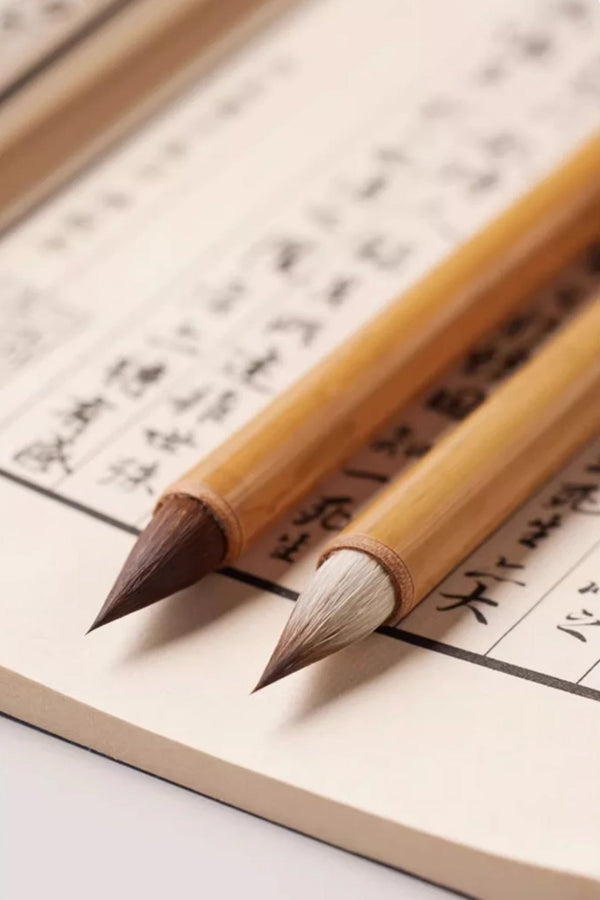
- the materials, also called "The Four Treasures"
- basic concepts about Chinese writing for those who don't know Chinese
- brush holding in Chinese calligraphy
- grid models for character imitation
- the three essential points of stroke in Chinese calligraphy
- the eight fundamental strokes
Once these prerequisites are mastered, learning will proceed in three stages:
I- Learning the fundamental strokes:
This is the first stage. You need to be able to recognize each stroke of a Chinese character. At the same time, you need to practice writing them. This will also develop your attention and be a great help in recognizing and decomposing a sinogram.
- Points (dian)
- Horizontal strokes (heng)
- Vertical strokes (shu)
- Hook (gou) page 1
- Hook (gou) page 2
- Raised strokes ("ti" or "tiao")
- The downward stroke from right to left (pie)
- Broken strokes (zhe) page 1
- Broken strokes (zhe) page 2
- Pressed strokes descending from left to right (na)
II- Learning to trace Chinese characters
To learn Chinese calligraphy, imitation is very important. To imitate characters from famous ancient calligraphers, two methods are generally used.
The first consists of copying characters placed in front of you on grids. You carefully observe the placement of the strokes or the general position of the character relative to the grid, and you write these characters on identical grids. This first method is called 'Duilin'.
The second method consists of studying the character at length and then calligraphing it from memory without having it in front of you. Grids are very helpful in studying characters.
III- Learning to write phrases
Finally, you will be able to start writing phrases: proverbs, poems, etc.
Traditionally, Chinese is written from top to bottom and right to left. It can also be written horizontally from left to right.