 English
 French
 Arabic
 Bulgarian
 Czech
Czech
 Danish
 German
 Greek
Greek
 Spanish
 Finnish
 Hungarian
 Indonesian
 Italian
 Hebrew
 Japanese
 Korean
 Dutch
Dutch
 Polish
 Portuguese, International
 Romanian
 Russian
 Slovak
 Swedish
 Thai
Thai
 Turkish
 Ukrainian
Accessories are 配饰 , literally “the ornaments you match”: 配, to go with, and 饰, to adorn. It is a magazine word; in conversation, you simply name the thing. The previous page (Clothes and shoes) dressed the body from head to toe; this one deals with what you add on top, then with the clothes of the past. First trap, already mentioned: you 穿 a garment, but you 戴 a hat, 戴帽子 . And a scarf? You wind it round, 围围巾 . A tie, for its part, is knotted: 打领带 (you can also say 系领带, but this 系 is read and catches every student out).
The hat, 帽子 , has a history you can read. The old character was 冒: a head covering, 冃, sitting above the eye, 目. But 冒 took on the meaning “to charge headlong”, then “to risk”; so the 巾 of cloth was added to the hat to tell it apart. That is the usual explanation, and it seems sound to me. A hat is counted with 顶, “the top”: 一顶帽子 .
In ancient China, your hat said who you were. At twenty, a young man received the cap of manhood, the 冠, and entered adulthood. Hence 张冠李戴 , “Zhang’s cap on Li’s head”: to get the wrong person (this is sentence 19). Under the Ming, officials wore a black gauze hat, and the 乌纱帽 still means the post you are afraid of losing. 戴高帽 , “to crown with a tall hat”, is what you do to the person you flatter; 扣帽子 , “to jam a hat on”, is what you do to the head of the person you accuse. In 2020, the last poor districts “took off their hats”, 摘帽. Giving someone a green hat, on the other hand, is still a very bad idea.
A bag is 包 , and the Shuowen sees in the character a belly wrapped round a child not yet formed. Everything that wraps is therefore 包: the 包子, the parcel, and the 包袱 , the bundle that became a burden. Careful with the backpack: 背包 is read with , “to carry on the back”, not , “the back”. Old clothes had no pockets; you kept your money in a purse hanging from your belt, hence 掏腰包 , “to rummage in your belt purse” ⟶ to pay out of your own pocket.
The other hiding place was the sleeve, wide and closed at the wrist. You slipped a book into it, a letter, a few coins. The minister 于谦 , under the Ming, is said to have gone up to the capital with nothing in his sleeves but “pure breeze”: 两袖清风 has since described an incorruptible official (the poem attributed to him is not certain). When you leave in anger, you shake your sleeves, 拂袖而去 . And the opera has kept the 水袖 , those “water sleeves” of white silk that extend the actor’s arm and express his anger or his grief.
The umbrella, 伞 , is a drawing: in the traditional form 傘, you can still see the stretched canopy and four little 人 sheltering underneath. Legend credits its invention to the wife of 鲁班 , the genius carpenter; nothing proves it. It is counted with 把, like everything with a handle: 一把伞 . But you don’t give one as a present. 伞 sounds like 散 , “to part”, and it is the same trap as the clock or the pear.
The fan, 扇子 , comes from a door: the Shuowen defines 扇 as a door leaf, and the character indeed combines 户, the door, with 羽, feathers. People still say 一扇门, “a door leaf”. The round fan, 团扇 , is the oldest; the folding fan, 折扇 , is said to have come from Japan by way of Korea, under the Song, according to most historians. As for 羽扇纶巾 , “the feather fan and the silk kerchief”, everyone sees Zhuge Liang in it. In Su Shi, however, it is Zhou Yu (this is sentence 23). Careful: in 纶巾, 纶 is read .
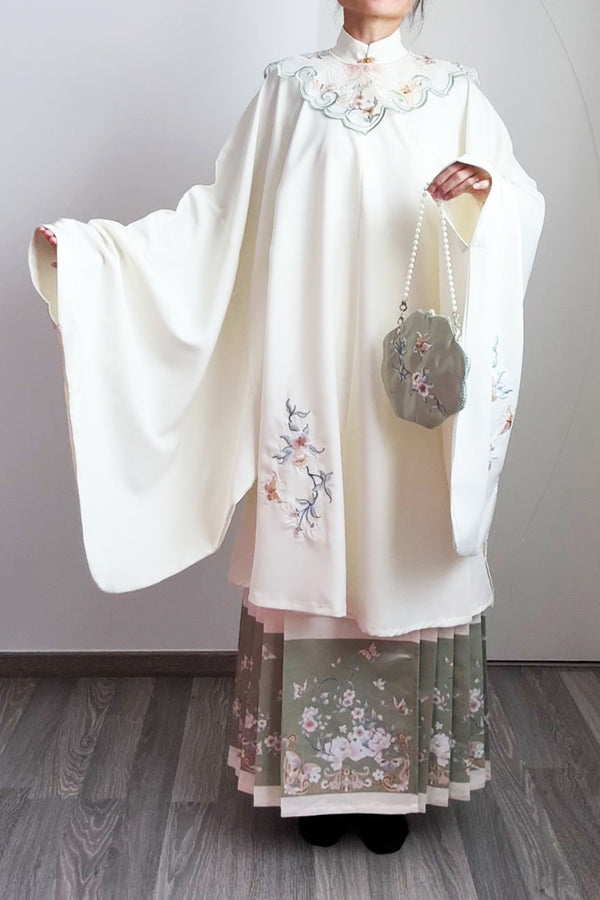
On to clothes. The 汉服 , “the dress of the Han”, can be recognised by its crossed collar closed to the right, 交领右衽 . This detail mattered enormously. Confucius says of Guan Zhong, the minister who drove back the barbarians: “Without Guan Zhong, we would have our hair hanging loose and the edge of our tunic fastened on the left side” (see Chapter 14 of the Analects of Confucius; this is sentence 25). Closing on the left meant dressing as a barbarian. Or as a corpse: the Liji prescribes closing the garments of the dead on the left.
The 旗袍 owes its name to the 旗人, “the Banner people”, in other words the Manchus (see The Qing dynasty). But the Manchu robe was loose and straight; the figure-hugging qipao we know was born in Shanghai in the 1920s (see The city of Shanghai), cut the Western way. What it really keeps from the Manchus is debatable. From the Qing also come the 马褂 , the horsemen’s short jacket, and the 马蹄袖 , the horse-hoof sleeve that covered the hand. The 长衫 , for its part, was the scholars’ gown: in Lu Xun, Kong Yiji is “the only one who drinks standing up while wearing the changshan”, a fallen scholar who won’t admit it.
The 中山装 jacket bears the name of Sun Yat-sen. Its four pockets are readily explained by four virtues, its five buttons by five powers, its three cuff buttons by the Three Principles of the People. I believe this symbolism was built after the fact, and there is even debate about who designed the jacket (this is sentence 17). The 唐装 , despite its name, owes nothing to the Tang: 唐人 refers to the overseas Chinese. It came back into fashion in 2001, when the heads of state at the APEC summit in Shanghai all wore it for the photo.
Old-style dress has its details: the knotted button, 盘扣 , the bride’s phoenix headdress, 凤冠霞帔 , the tiger-head shoes, 虎头鞋 , which protected babies. On the mandarins’ robes, an embroidered square, the 补子 , showed a bird for civil officials, a wild beast for military ones. The story goes that 衣冠禽兽 , “beast in mandarin’s robes”, was first an honourable title, which became an insult at the end of the Ming. It is a pretty story; I have found no proof of it.
The 汉服 is back in fashion, to the point that people talk of 汉服热 . Its fans call each other 同袍 , “same cloak”, after the Shijing song quoted on the previous page. The 马面裙 , the “horse-face” skirt, brought Chinese students out in 2022 in front of a Dior boutique in Paris, which was accused of selling a copy of it without saying so. Designers talk of 国潮 , trendy Chinese fashion, and of 新中式 , the neo-Chinese style.
Han Feizi, for his part, was wary of accessories. A merchant from Chu sold a pearl in a casket of precious wood, perfumed and inlaid with jade; his customer from Zheng kept the casket and gave back the pearl (买椟还珠 ). The comment is curt: “One can say that he knew how to sell caskets; one cannot say that he knew how to sell pearls” (this is sentence 24). Keep the pearl.
Click on any character on the page: its stroke order is shown stroke by stroke, with the arrow that gives the direction of the movement.
How to use this page: every word carries its level. ① the essentials, ② the common, ③ the precise. Start with the ①: they are already enough to talk about your bags, hats and umbrellas. The ▶ button gives the pronunciation, and a click on a character opens its stroke order.
Hats and caps
the hat, the cap
to put on a hat (戴, not 穿)
a hat (顶, measure word for hats)
the straw hat
the peaked cap (“duck-tongue hat”)
the baseball cap
the woolly hat
the hard hat
the brim, the peak
the formal hat
the sun hat
the conical peasant hat
the skullcap (“melon-rind hat”)
Scarves, ties, belts
the scarf
the tie
the leather belt
the belt (cloth or leather)
the silk scarf
the bow tie
the cloth handkerchief
the neck warmer (northern word)
the red scarf (of the Young Pioneers)
the shawl, the stole
the earmuffs
the cufflink
the belt buckle
Bags
the bag
the school bag, the satchel
the wallet
the backpack, the rucksack
the handbag
the shopping bag
the shoulder bag, the messenger bag
(colloq., reduplicated) the bag, especially a woman’s bag
the designer bag
the bag strap, the handle
the coin purse
the canvas bag
the briefcase
the bum bag (belt bag)
Umbrellas, fans, small items
the umbrella, the parasol
the umbrella (“rain parasol”)
an umbrella (把, measure word for things with a handle)
to hold an open umbrella
to take one’s umbrella
the fan
the folding umbrella
the keyring
the folding fan
the round fan (silk)
the oiled-paper parasol
Wearing and matching
to carry one’s school bag on one’s back
to knot one’s tie
to undo one’s tie
to put on one’s scarf
to carry a bag in one’s hand
to take off (hat, glasses, jewellery)
to go with, to match
to coordinate; the combination
costume jewellery, ornaments
to carry on the arm, over the shoulder
the accessory (fashion term)
The great Chinese garments
traditional clothing
the hanfu, the dress of the Han
the qipao (“Banner robe”)
the Chinese jacket (“Tang attire”)
the Sun Yat-sen jacket (“Zhongshan attire”)
formal wear, ceremonial dress
the official’s robe (of old)
the stage costume, the opera costume
the short Manchu jacket (“horse jacket”)
the scholars’ long gown
the imperial dragon robe
mourning dress
the fibre rain cape (of peasants)
Old-style dress in detail
the knotted button (“coiled button”)
the embroidered slippers
the centre fastening (“flaps facing each other”)
the crossed collar closed to the right
the wide sleeve
the “water sleeve” (silk extension in opera)
the horse-hoof sleeve (of the Qing)
the embroidered mandarin square
the “cloud shoulder” collar
the bride’s phoenix crown and stole
the belly cover
the tiger-head shoes (for babies)
Chinese dress today
to wear the hanfu
period costume (in TV series)
the “old-style” look
Chinese style
“trendy Chinese” fashion
the neo-Chinese style
the “horse-face” skirt
the modernised qipao
the comrade-in-arms; (among hanfu fans) the fellow enthusiast
“Han elements” (modern clothes with ancient touches)
the hanfu craze
Accessories in sayings
“Zhang’s hat on Li’s head”: to get the wrong person
to pay out of one’s own pocket
“to crown with a tall hat”: to flatter
“to jam a hat on”: to pin a label on someone
“the black gauze hat”: an official post
“two sleeves of pure breeze”: incorruptible
to storm off with a flick of the sleeve
“to open one’s purse generously”
“a beast in mandarin’s robes”: a scoundrel
“feather fan, silk kerchief”: the strategist’s elegance
to vouch for, to guarantee
“to wrap up the ten thousand things”: to embrace everything
“to buy the casket and return the pearl”
Accessories in everyday words
to include, to comprise
the packaging
the backpacker (“backpack traveller”)
the parachute (“parasol for coming down”)
the discount
to lose points, to be penalised
to crowd round to watch
around; the surroundings
to lead, to guide
to tolerate, to be forgiving
the bundle; the burden
“the protective umbrella”: a protector in high places
the hat-trick (three goals)
“to take off the hat”: to shed a label
Example sentences
It’s cold outside: put your hat on.
It’s going to rain: don’t forget your umbrella.
I’ve lost my wallet!
Mum knitted this scarf.
Every day he goes to school with his school bag on his back.
The qipao really suits her.
Dad has to wear a tie for work.
This bag is too expensive.
Which bag would go with this outfit?
At New Year, Grandad likes to wear his Chinese jacket.
These days, lots of young people go out and about in hanfu.
He left his umbrella on the metro.
In summer, with a straw hat on, you needn’t fear the sun.
Primary schoolchildren wear the red scarf.
I bought this fan in Suzhou.
Don’t put your hat on crooked.
Was the Zhongshan jacket really designed by Sun Yat-sen?
As soon as he came in, he took off his hat.
You’ve got the wrong author: Confucius never said that.
Stop pinning labels on people at the drop of a hat.
Thirty years in office, and his hands still clean.
At these words, he stormed off with a flick of his sleeve.
Feather fan, silk kerchief: amid talk and laughter, masts and oars go up in ash and smoke.
One can say that he knew how to sell caskets; one cannot say that he knew how to sell pearls.
Without Guan Zhong, we would have our hair hanging loose and the edge of our tunic fastened on the left side.