English
 French
 Arabic
 Bulgarian
 Czech
 Danish
 German
 Greek
 Spanish
 Finnish
 Hungarian
 Indonesian
 Italian
 Hebrew
 Japanese
 Korean
 Dutch
 Polish
 Portuguese, International
 Romanian
 Russian
 Slovak
 Swedish
 Thai
 Turkish
 Ukrainian
The word for cloth is 布 . For centuries it was the fabric of the poor, woven from hemp, while silk was the fabric of the rich: a 布衣 , “a garment of cloth”, meant a man of the people, and Zhuge Liang writes in his famous memorial to the emperor 臣本布衣, “your servant was only a man in cloth”. The same character also means “to spread out”, hence 宣布 , to announce, or 布局 , the way things are laid out. The previous page (Accessories and traditional dress) finished dressing the body; this one deals with what clothes are made of, their colour and their size.
Cotton, 棉花 , came late. Before the Song, cloth was made of hemp, ramie or kudzu; cotton spread under the Yuan, and tradition gives the credit to 黄道婆 , a woman from Songjiang who is said to have brought back from Hainan the art of spinning it (how much of this is legend is hard to say). Today, the label says 面料 , literally “the material of the face”, then 纯棉 , pure cotton, or else 涤纶 , polyester. Cashmere is 羊绒 , “the down of the sheep”, finer than wool, 羊毛.
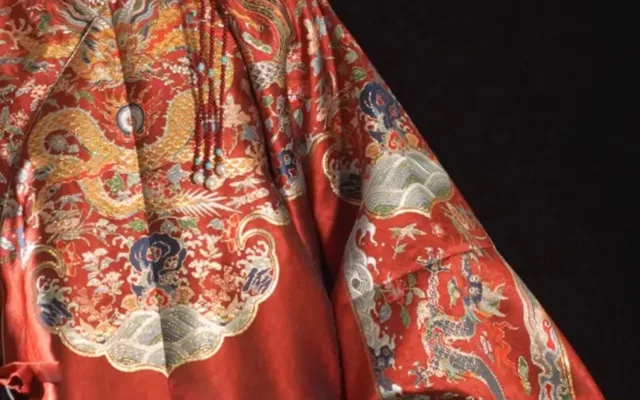
But the true Chinese material is silk. Look at the character 丝: two skeins twisted side by side. This thread turns up again, in the form of the radical 纟, in almost all the vocabulary of textiles: 线, 织, 纺, 绸, 缎, 绣. And, more surprisingly, in colours: 红, 绿, 紫. The Shuowen defines each of them as a colour of dyed silk: 红, for example, is “a silk of a red verging on white”. Bright red was 赤; 红 was pink to begin with. A colour, in ancient Chinese, is a thread that has been dipped.
The silkworm, 蚕 , has its legend: 嫘祖 , the wife of the Yellow Emperor, is said to have seen a cocoon fall into her bowl of tea and unwind into an endless thread. It cannot be checked, of course. On the other hand, archaeologists have found fragments of silk in China that are nearly five thousand years old. The simplified character is often read as 天 above 虫, “the insect of heaven”; it is pretty, but it is a reading after the fact, since the traditional form is 蠶. The cocoon has given a stern expression: 作茧自缚 , “to spin a cocoon and tie yourself up in it” ⟶ to be caught in your own trap.
The 丝绸之路 has no ancient Chinese name: it was the German geographer Ferdinand von Richthofen who spoke of the “Silk Road” (Seidenstraße) in 1877, and Chinese, like English, translated the word. It started from 长安 , today’s Xi’an (see Xi’an; this is sentence 17). The Romans, who bought silk without knowing where it came from, called the Chinese the Seres, “the silk people”.
Embroidery is 刺绣 , “to prick and embroider”. There are four great schools, those of Suzhou, Hunan, Sichuan and Canton; the best known is 苏绣 , whose embroiderers make portraits as fine as paintings (sentence 16). Brocade is 锦. You often read that there is gold, 金, in the character; careful, the Shuowen files it under silk, 帛, and makes 金 merely the phonetic part. Nanjing drew from it its 云锦 , the “cloud brocade”. And embroidery has its downside: an 绣花枕头 , “an embroidered pillow”, is pretty outside and stuffed with straw inside.
Now for trying things on. Sizes are 号, the number: 大号 , 中号 , 小号 . The Chinese label often gives something else, such as 170/88A: height in centimetres, chest measurement, body type. Shoe size, for its part, is 码: 39码. Careful, clothes cut for the Chinese market come up small, at least the ones I have bought; hence sentence 4, to be learnt by heart. You go into the 试衣间 , you judge whether it is 合身 , and you hear 显瘦 , “that makes you look slim”, a great deal: it is the number one sales pitch.
Now for colours. The word 颜色 first spoke of the face: for the Shuowen, 颜 is “the space between the eyebrows and the eyes”, and 色 “the look of the face”. The colour of things came later. In conversation, people readily drop the 色: 穿红的, “to wear red” (sentence 8). On the other hand, 彩色 is kept for colour as opposed to 黑白 , black and white, as for a photo.
The real trap is called 青 . This word covers the blue of the sky, 青天, the green of grass, 青草, and even the black of hair, 青丝. Translating it means choosing, and you get it wrong one time in two. Xunzi opens his chapter on learning with a dyer’s sentence: “qing is drawn from the indigo plant, and it is bluer than the indigo plant” (sentence 23). 蓝 is the plant here, not the colour. Hence 青出于蓝 : the pupil who surpasses the master (sentence 19). For a teacher, it is the finest of compliments; it is also a little galling.
Colours have their system too. The five colours, 五色 , correspond to the five elements (see Fundamental theory of Chinese medicine): qing for wood and the east, red for fire and the south, white for metal and the west, black for water and the north, and yellow for earth, at the centre. The centre is the emperor: under the Qing, imperial yellow, 明黄 , was reserved for him. Yellow has gone downhill since. 黄色 now describes pornographic films, perhaps under the influence of the American “yellow press”, but nobody really knows. And a project that has 黄了 has fallen through (sentence 21); there again, I have found no reliable explanation.
Red is the colour of celebration, 喜庆 , and of weddings. White is the colour of mourning, because mourning refuses dye: 素 is raw silk, and mourning dress is still called 素服. Confucius uses it in a fine reply: “Before painting, one must have a white ground”, 绘事后素 (Analects, III, 8). Modern vocabulary, for its part, borrows from English: 白领 and 蓝领 are calques of white collar and blue collar, as is 黑名单 of blacklist. But 眼红 , “to have red eyes” ⟶ to be jealous, is Chinese through and through.
Mozi, watching dyers at work, sighed: “Dyed in blue, it turns blue; dyed in yellow, it turns yellow” (sentence 24). He drew a political lesson from it: a prince takes on the colour of the people he keeps company with. Under the Jin, Fu Xuan would say the same thing more briefly: 近朱者赤,近墨者黑 , “whoever comes near vermilion turns red, whoever comes near ink turns black”.
Confucius, lastly, had principles where colour was concerned: at home, he wore neither “red verging on white”, as Couvreur translates, nor purple (see Chapter 10 of the Analects of Confucius). And he said 恶紫之夺朱也 (see Chapter 17 of the Analects of Confucius; this is sentence 25). Couvreur translates: “I do not like the colour purple, because it is darker than red.” Yet the verb 夺 means “to seize”: purple, a mixed colour, was taking the place of vermilion, the true colour, just as the music of Zheng was driving out good music. Purple has had its revenge. The Forbidden City is called 紫禁城, even if this 紫 comes from the Pole Star rather than from the dyer’s vat. It ended up in the palace.
Click on any character on the page: its stroke order is shown stroke by stroke, with the arrow that gives the direction of the movement.
How to use this page: every word carries its level. ① the essentials, ② the common, ③ the precise. Start with the ①: they are already enough to choose a colour and ask for your size. The ▶ button gives the pronunciation, and a click on a character opens its stroke order.
Fabrics
cloth, fabric
cotton (the plant, the fibre)
pure cotton
wool
material (what a garment is made of)
fabric sold by the metre, a length of cloth
fabric (on a label), the outer fabric
linen or hemp cloth
denim
cashmere
leather
synthetic fibre
polyester
Silk and embroidery
silk (the fabric)
real silk (as opposed to synthetic)
the silkworm
silk thread, raw silk
the Silk Road
embroidery
to embroider (flowers), to do embroidery
to rear silkworms
Suzhou embroidery
satin
silks, silk fabrics
Nanjing brocade (“cloud brocade”)
Sewing, knitting, judging a fabric
the needle
thread
thick
thin (fabric, garment)
to sew
to knit a jumper
the tailor, the dressmaker
breathable (lets the air through)
that keeps you warm
to run, to lose colour
textiles (spinning and weaving)
to pill, to bobble
the patch (on a mended garment)
the sewing machine
Colours
red
white
black
yellow
blue
green
grey
pink
purple
orange (the colour)
brown
gold (the colour), golden
silver (the colour), silvery
in colour (as opposed to black and white)
Light, dark, bright
dark colours
light colours
black and white
dark blue
light blue
sky blue
bright, vivid (colour)
plain, all one colour
dark green (“ink green”)
navy blue
burgundy (“wine red”)
off-white (“rice white”)
Dyeing, and the colours of China
to dye, dyeing
qing: blue-green (depending on the period, from blue to green, even black)
festive, joyful (the red of celebrations)
the five colours (qing, red, yellow, white, black)
vermilion
bright yellow, imperial yellow
indigo
tie-dye (dyeing with knots)
wax-resist dyeing, batik
blue-and-white porcelain
painting (“red and qing”)
Patterns
the pattern, the design
stripes
checks
decoration, ornament (on a fabric, an object)
small flowers (floral pattern)
a print (printed fabric)
polka dots
leopard print
camouflage (pattern)
dragon motif
cloud motif
Sizes and trying on
large (L)
medium (M)
small (S)
size (of clothes), shoe size
to try on (a garment)
the fitting room
suitable, the right size
well-fitting, that fits well
the style, the cut
loose, roomy
tight
slimming
fitted, close to the body
one size
Colours and fabrics in sayings
of every colour
scrupulous, not neglecting a single thread
blue comes out of indigo: the pupil surpasses the master
black and white clearly separated: clear-cut, unambiguous
to swap black for white: to twist the truth
whoever comes near vermilion turns red, whoever comes near ink turns black
a thousand purples and a thousand reds: a riot of flowers
without telling blue from red or black from white: without trying to understand
to shut oneself in one’s own cocoon: to be caught in one’s own trap
an embroidered pillow (pretty outside, straw inside)
every thread in its place: perfectly precise
Colours and fabrics in everyday words
the number
to envy, to be jealous (“to have red eyes”)
the blacklist
the white-collar worker, the office worker
to lose heart (“an ash-coloured heart”)
colouring, tone (of a work, a speech)
the clue, the lead
the blue-collar worker, the manual worker
to give the green light
to fall through (of a project)
to make a wasted journey
the slightest bit (“a thread, a hair”)
the layout, the arrangement
Example sentences
What colour do you like?
This shirt is pure cotton.
Can I try it on?
Do you have it in the next size up?
This jumper is a bit thin.
I don’t like black: do you have it in red?
Where’s the fitting room?
Chinese people like to wear red for their wedding.
This garment lost its colour after the very first wash.
Silk feels smooth to the touch.
This one is too tight: haven’t you got anything looser?
Dark colours are slimming.
I like stripes, not checks.
When she was young, Grandma wove her own cloth.
In winter, wool keeps you warmer.
Suzhou embroidery is painting with a needle and thread.
The Silk Road ran from Chang’an all the way to the Mediterranean.
This colour is too loud: I wouldn’t dare go out in it.
The pupil has surpassed the master: that’s what we call “blue that came out of indigo”.
You told him off without trying to understand: that’s not fair.
The money never came: the project fell through.
As soon as spring arrives, the park is covered in flowers of every colour.
Qing is drawn from the indigo plant, and it is bluer than the indigo plant.
Dyed in blue, it turns blue; dyed in yellow, it turns yellow.
I do not like the colour purple, because it is darker than red.