English
 French
 Arabic
 Bulgarian
 Czech
 Danish
 German
 Greek
 Spanish
 Finnish
 Hungarian
 Indonesian
 Italian
 Hebrew
 Japanese
 Korean
 Dutch
 Polish
 Portuguese, International
 Romanian
 Russian
 Slovak
 Swedish
 Thai
 Turkish
 Ukrainian
Chinese painting is 国画 , “national painting”, or 中国画 (see Chinese painting). The word is recent: it only took hold in the 20th century, to distinguish traditional painting from the oil painting that came from the West. Before that, people simply said 画. After Theatre, cinema and photography, here is the last page on the arts.
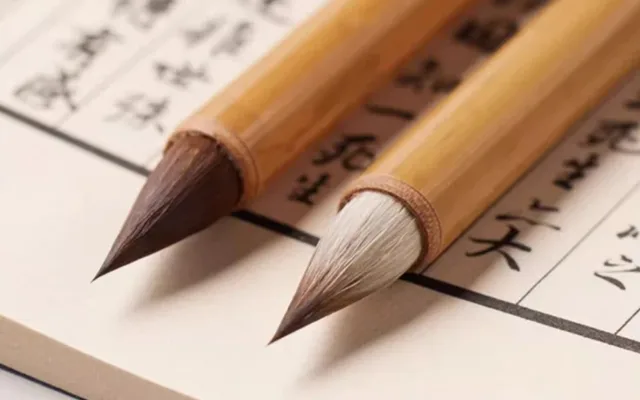
Two great manners share Chinese painting between them. 工笔 , “the careful brush”, traces every detail; 写意 , “writing the idea”, captures the spirit in a few brushstrokes. Note the verb: in Chinese, you “write” a painting. 写生 , “writing the living”, is painting from life; 速写 , “writing fast”, is sketching. Painting and calligraphy share the brush, the ink and the paper, and the language has never really separated them.
Ink alone is enough for a painting, since 墨分五色 , “ink has five colours”, from deep black to the palest grey. On the other hand, don’t ask me which ones: the old lists do not agree on the five. The number mostly says that black is never just one black.
What is not painted counts as much as the rest. 留白 , “keeping the white”, leaves it to the paper to represent the sky, the water or the mist (sentence 9). Confucius already said 绘事后素, “before painting, one must have a white ground” (sentence 25, see Chapter 3 of the Analects of Confucius, III.8). Careful: the exact meaning of the phrase has been debated since antiquity, and it is his disciple Zixia who at once draws a lesson on the rites from it. Landscape, for its part, did not yet exist as a genre.
A Chinese painting is not hung as it is: it has to be mounted, backed with paper, 装裱 (see Mounting Chinese paintings). It then becomes a scroll, 卷轴 . The 手卷 , the handscroll, unrolls from right to left, one section after another. You read it like a book.
Chinese architecture is made of wood, 木结构 (sentence 13). This is its strength (the timber frames bend without breaking) and its weakness: fire and time have decimated it. The oldest wooden building still standing in China, the great hall of the Nanchan temple, in Shanxi, dates from 782. The upturned eaves, the 飞檐 , are “eaves that fly”, and the yellow glazed tiles, the 琉璃瓦 , were reserved for imperial buildings and for the temples the emperor honoured (sentence 15).
Old Beijing is built on a north-south axis, the 中轴线 (sentence 14), which runs through the Forbidden City. It has been a Unesco World Heritage Site since 2024. It is symmetry pushed to the scale of a city.
The Chinese garden, 园林 , breaks with this symmetry. In it you find 假山 , “false mountains” made of 太湖石 , those stones hollowed out by the water of Lake Tai, 漏窗 , “windows that let the gaze leak out”, and the art of 借景 , “borrowing the scenery” (sentence 20). In Shanghai, Yu Garden is a fine example, from the Ming period.
Su Shi said of Wang Wei’s works that there were paintings in his poems and poems in his paintings (sentence 23). The same could be said of a Suzhou garden: it is a painting you walk through. Still, you have to take your time.
Click on any character on the page: its stroke order appears stroke by stroke, with the arrow showing the direction of the line.
How to use this page: every word carries its level. ① the essentials, ② the common, ③ the precise. Start with the ①: they are already enough to talk about painting, architecture or gardens. The ▶ button gives the pronunciation, and a click on a character opens its stroke order.
Chinese painting
Chinese painting, “national painting”
ink painting, “water and ink painting”
landscape painting, “painting of mountains and waters”
bird-and-flower painting
figure painting
meticulous style, “careful brush”
freehand style, “writing the idea”
empty space (left in a painting), “keeping the white”
literati painting
line drawing without colour, “tracing in white”
splashed ink, “throwing the ink”
wrinkles (strokes that give rocks their texture)
colouring, “applying colour”
painting without outlines, “without bones”
ink has five colours (five shades of ink)
Formats and mounting
inscription (on a painting); to inscribe
painted scroll; picture (figurative)
scroll (for hanging or unrolling)
handscroll, “hand scroll”
album (of paintings)
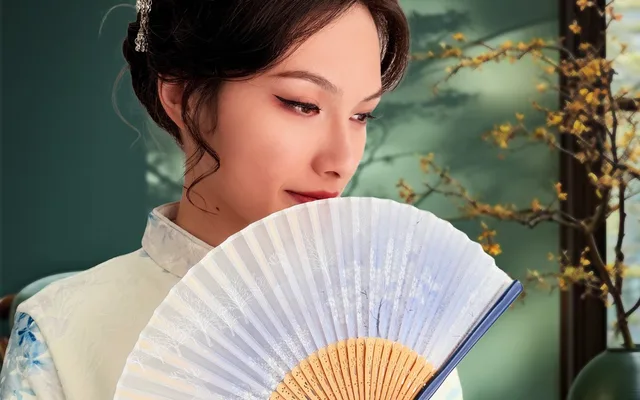
fan leaf (painted)
mounting, backing (of a painting)
Western painting
oil painting
watercolour
drawing (in pencil), “simple tracing”
paint, colours (material)
paintbrush (artist’s)
to paint from life, “to write the living”
canvas
landscape (picture)
sketch, “writing fast”
frame
drawing board
self-portrait
abstract painting
portrait
still life, “motionless things”
realistic, “writing the real”
palette
Impressionism, “the Impressionist school”
perspective
chiaroscuro, “light and dark”
Sculpture and decorative arts
sculpture
to engrave, to carve; engraving
mural, fresco
print, engraving (artwork)
New Year picture
graffiti, scribble, “to daub like a crow”
jade objects
Tang three-colour ceramics
cloisonné enamel, “Jingtai blue”
lacquer, lacquerware
installation (contemporary art)
Art and museums
art
fine arts, “the art of beauty”
work of art
work
painting exhibition
exhibition; to exhibit
to appreciate, to admire
art class
masterpiece, famous painting
museum (large museum, like the Palace Museum)
auction; to auction
national treasure
original, authentic work, “true trace”
entrance exam for art schools
Chinese architecture
palace
pagoda
column, pillar
step, steps
eaves
ancient architecture, old building
beam
main hall (of a palace, a temple)
stone lion
Temple of Heaven
red wall
courtyard, inner courtyard
central axis
ceremonial archway
upturned eaves, “eaves that fly”
glazed tile
wooden structure
multi-storey pavilion
Huizhou architecture (Anhui)
Chinese gardens
(Chinese) garden
pavilion, kiosk
rockery, “false mountain”
arched bridge
gardens of Suzhou
pebble, “goose-egg stone”
path, alley
Summer Palace
covered gallery
moon gate (round doorway)
Humble Administrator’s Garden (Suzhou)
zigzag bridge
Taihu stone
lattice window, “window that lets leak”
borrowed scenery, “to borrow the scenery”
waterside pavilion
The arts in set expressions
pavilions, terraces and towers (the buildings of a garden)
carved beams and painted ridgepoles (a sumptuous building)
thick ink and heavy colours (to stress forcefully)
to trace lightly, to write pale (to play down)
too many beauties to take them all in
of original ingenuity
to paint sound and colour (to tell vividly)
to paint the gourd from the model (to copy without creating)
the breath gives life (first principle of Chinese painting)
The arts in everyday words
picture, image (of a film, a screen)
to describe (in writing), “to trace and write”
background colour; (a person’s) basic nature
tone (of colours)
style (of drawing), atmosphere
to embellish
framework, structure
plan, blueprint, “blue drawing”
outline, broad lines
to adorn, to decorate
to sketch, to trace the outlines
to chisel; to overwork (a text)
to whitewash (the truth), “to whiten”
to skim over, “in one brushstroke”
Example sentences
I am learning Chinese painting.
This landscape is really beautiful!
Let’s go to a painting exhibition this weekend.
The Forbidden City has a great many palaces.
There is a pavilion in the park.
My daughter loves art class.
He painted a landscape in oils.
Who is this work of art by?
Chinese painting attaches great importance to empty space.
To learn fine arts, you start with drawing.
In the gardens of Suzhou, every step reveals a different view.
Is this painting the original or a copy?
Ancient Chinese buildings are mostly made of wood.
Beijing is crossed by a north-south central axis.
The roofs of the Forbidden City are almost all covered in yellow glazed tiles.
He is painting from life in the park.
This text describes old Beijing very vividly.
It is only a plan, construction has not started.
Literati painting seeks the spirit rather than the likeness.
The Chinese garden practises borrowed scenery: it “borrows” even the distant mountains.
He played the matter down and dismissed it in one sentence.
With its pavilions, terraces and towers, this garden offers more beauties than one can take in.
Su Shi said of Wang Wei’s work: “in his poems there are paintings; in his paintings, poems”.
In 2017, Qi Baishi’s “Twelve Landscapes” sold at auction for more than 900 million yuan.
Before painting, one must have a white ground. (Confucius, Analects, III.8)