 English
 French
 Arabic
 Bulgarian
 Czech
Czech
 Danish
 German
 Greek
Greek
 Spanish
 Finnish
 Hungarian
 Indonesian
 Italian
 Hebrew
 Japanese
 Korean
 Dutch
Dutch
 Polish
 Portuguese, International
 Romanian
 Russian
 Slovak
 Swedish
 Thai
Thai
 Turkish
 Ukrainian
The basic writing unit of a Chinese character, or sinogram, is the stroke. Chinese writing has 8 basic strokes:
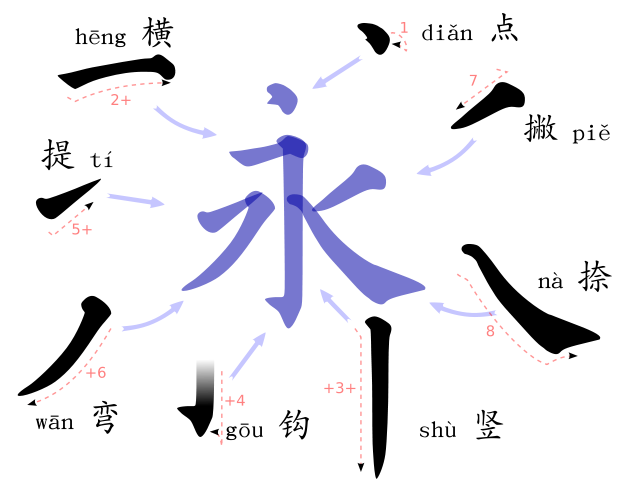
These 8 simple strokes have many variants, 29 in all, called "compound strokes". But it is better not to learn them at first. All you need to know is that these 8 basic strokes can vary.
With these 8 basic strokes and their variants, you can write a hundred or so fundamental Chinese characters called graphic components. Some graphic components are words in their own right, such as 马 (horse); others never appear on their own, such as the water component 氵, which is only ever found together with other components. By combining these components, you can create an endless number of Chinese characters. To a beginner, learning the graphic components may seem pointless or even tedious, but it makes Chinese characters much easier to memorize later on.
Note
You will often hear about "radicals" (also called "keys"). The radical of a Chinese character is the graphic component used to classify it and look it up in a dictionary. Modern dictionaries list 214 radicals. When it comes to how a Chinese character is built, it is better to talk about graphic components than about radicals. A Chinese character has only one radical, but it can be made up of several graphic components. Moreover, some important graphic components are not on the list of radicals. Finally, many radicals are themselves built from several graphic components.
Writing rule
A Chinese character is written inside an imaginary square. If the character is made up of several components, which is almost always the case, the components must not be too far apart: they must all fit inside the same square, otherwise they will be read as separate characters. For example, the character 好 is made up of two components. If you do not write them both inside the same imaginary square, you get: 女子.
When you learn to write a Chinese character, you must always follow the stroke order, that is, the order and direction in which the strokes are written.
There are seven essential rules for writing Chinese. You can read them on this page: The rules of Chinese writing. Remember that vertical strokes are always written from top to bottom, and horizontal strokes from left to right.
You learn to write Chinese on plain sheets of paper, such as printer paper. A ballpoint pen is perfectly fine for practice. You write lines of characters in grids designed for this purpose. The chine-culture.com website offers a tool that generates writing grids for practice. In this online Chinese course, you can download and print the writing grids for each lesson to practice.
The writing grids for this lesson, along with a sample of a completed writing grid, can be downloaded from Unit 1 of the full course on Learn-chinese.online.